


Thermal Fixation: Achieving Effective Fixation of Functional Powders in Textiles

Updated: Oct 8
There are several ways to integrate powders into textiles. The methods primarily used include powder scattering, electrostatic impregnation (Fibroline’s technologies), and liquid-based processing followed by a drying step. To ensure proper integration of the powder within the textile as well as the durability of the given function, the material must be fixed.
What is a fixation step?
To achieve optimal fixation of a powder in a textile, it is essential to apply this powder uniformly and homogeneously across the substrate. Thus, the fixation step consists of bonding the powder to the substrate to prevent it from being released during the final product’s lifespan.
Fixation: how is it performed?
For the fixation of functional powders in textiles, thermal treatment methods are most commonly used. With these techniques, fixation depends on the thermal properties of the materials, namely the porous substrate and the active powder. The main goal is to exceed the melting temperature of some of the materials acting as binders. The fixation step consists in melting the materials: it can be achieved by melting either the powder or the fibers of the porous substrate. However, it is essential to ensure that the degradation temperature of the materials constituting the product is never reached, so as not to alter the properties of the final product.
Melting of the powder:
Melting the powder will cause it to form adhesive points that enable adhesion to the substrate. There are two approaches depending on the active powder’s properties:
If the active powder has a melting temperature, it can be melted and thereby fixed to the substrate.
If the active powder does not melt on its own, it can also be mixed with a binding powder. The binder will guarantee the fixation of the active powder in the porous support by making it benefit from its own binding capacity.
Melting of the fiber:
An alternative to binding powders is to use fusible fibers. When the fiber is melted, it will encapsulate the powder. There are many methods to proceed:
Lamination of surface layers: the porous substrate and the powder are sandwiched between two layers of a textile material. During this process, the material is heated and partially compressed inside a calender to melt the superficial layers. This results in a multilayer final product.
Bi-component fibers: the fiber core consists of one material, while the outer sheath is made of another material with a lower melting point than the core. Only the outer layer melts, providing the desired adhesion, while the core remains completely intact.


Fixation equipment:
Several types of equipment are capable of performing a fixation by thermal treatment. They can be divided into two categories: static equipment primarily used at laboratory scale and for small-volume production, and dynamic equipment used for continuous, larger-scale productions.
Static treatment:
Pneumatic heated-plate press: This heat-treatment machine allows for precise control over temperature, sample dimensions, and thickness. It combines heat and pressure during the fixation process.
Oven: This unit heats up its entire environment without compressing the samples. However, the treatment generally requires a longer processing time.
Dynamic treatment:
Flatbed laminating calender: This is a preferred fixation method for many industrial applications. It applies pressure simultaneously with the thermal treatment and provides a uniform heating area across the entire width of the material.
Infrared (IR) oven: This allows the material to be heated without compression, thereby preserving its 3D structure. The material is first pre-melted in the IR oven and then compressed using a calender. Precise temperature control is required to prevent damage to the materials.
Through-air oven: This is typically used when the fixation step is combined with a drying step. It operates without compression and enables the materials to be dried, making it suitable for liquid-based functionalization processes. However, it is rarely considered for powder bonding in dry-process solutions.

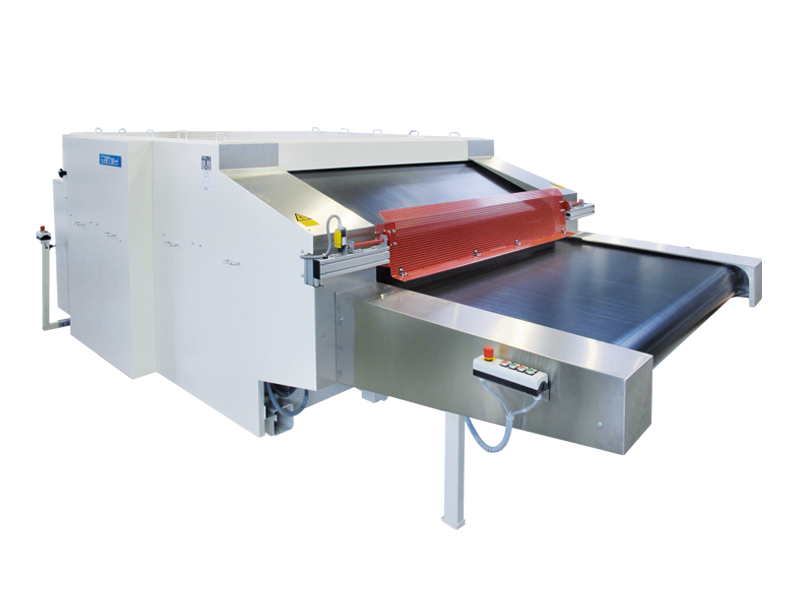
These pictures show a pneumatic heated-plate press and a flatbed laminating calender.
Analysis and quality control of thermal treatment
In order to ensure the desired properties of the final product, it is important to assess the quality of the treatment both during and after this fixation step. Indeed, the various thermal treatment machines operate with a setpoint temperature that often differs from the exact actual temperature experienced by the material, particularly due to thermal inertia.
The heating time, the type of heated material, the calender speed, and consequently the dwelling time (i.e. the heating and cooling times) of the material within the fixation equipment are all factors that affect the actual temperature experienced by the material during thermal treatment. Another important factor influencing this temperature is the material amount. The greater the quantity of powder within the porous substrate, the longer it takes for heat to reach the core of the material.
The moisture content also plays a role in the thermal behavior of the material during fixation. This humidity may originate from the materials’ natural hygroscopicity or result from liquid-based impregnation. A shift in the temperature profile slope around 100°C is commonly observed, corresponding to water evaporation during the fixation process. This phenomenon tends to slow down heat transfer through the material.

The purpose of this analysis is to ensure that the process operates as close as possible to the melting temperature of the material, in order to guarantee the quality and reproducibility of the products obtained after treatment. Thus, thermocouples are inserted into the fixation device to enable effective observation and accurate tracking of the temperature during the thermal treatment. The monitoring of the temperature felt is therefore done qualitatively throughout the heating phase.
The heating cycle can then be precisely defined according to the type of machine selected to perform the fixation process.

To wrap up:
Thermal powder fixation methods have demonstrated their effectiveness in functionalizing textiles. However, several factors must be taken into account:
Melting of the powder or textile fiber: it is important to ensure that the material melts properly in order to achieve effective fixation;
Production and sample size: these factors will determine the choice of fixation method;
Process temperature control: qualitative monitoring using thermocouples has proven reliable in ensuring proper thermal evolution of the product during treatment. This also makes it possible to verify the accuracy of the temperatures reached.
By carefully controlling these conditions, the thermal fixation provides an effective way of trapping the powder in the substrate and contribute to the long-term performance of the final product.
This article was edited and published by Sylvain Batut.


Comments